

Welcome to the digital program for the Duke Department of Neurology 2026 Research Symposium! On this webpage, you will find the symposium schedule, information about the keynote speaker presentation, and details of the poster presentations from members of the Duke community.
Tuesday, September 15, 2026 | 4:00PM - 6:30PM
Trent Semans Great Hall | Duke University
Congratulations to the 2026 Award Winners
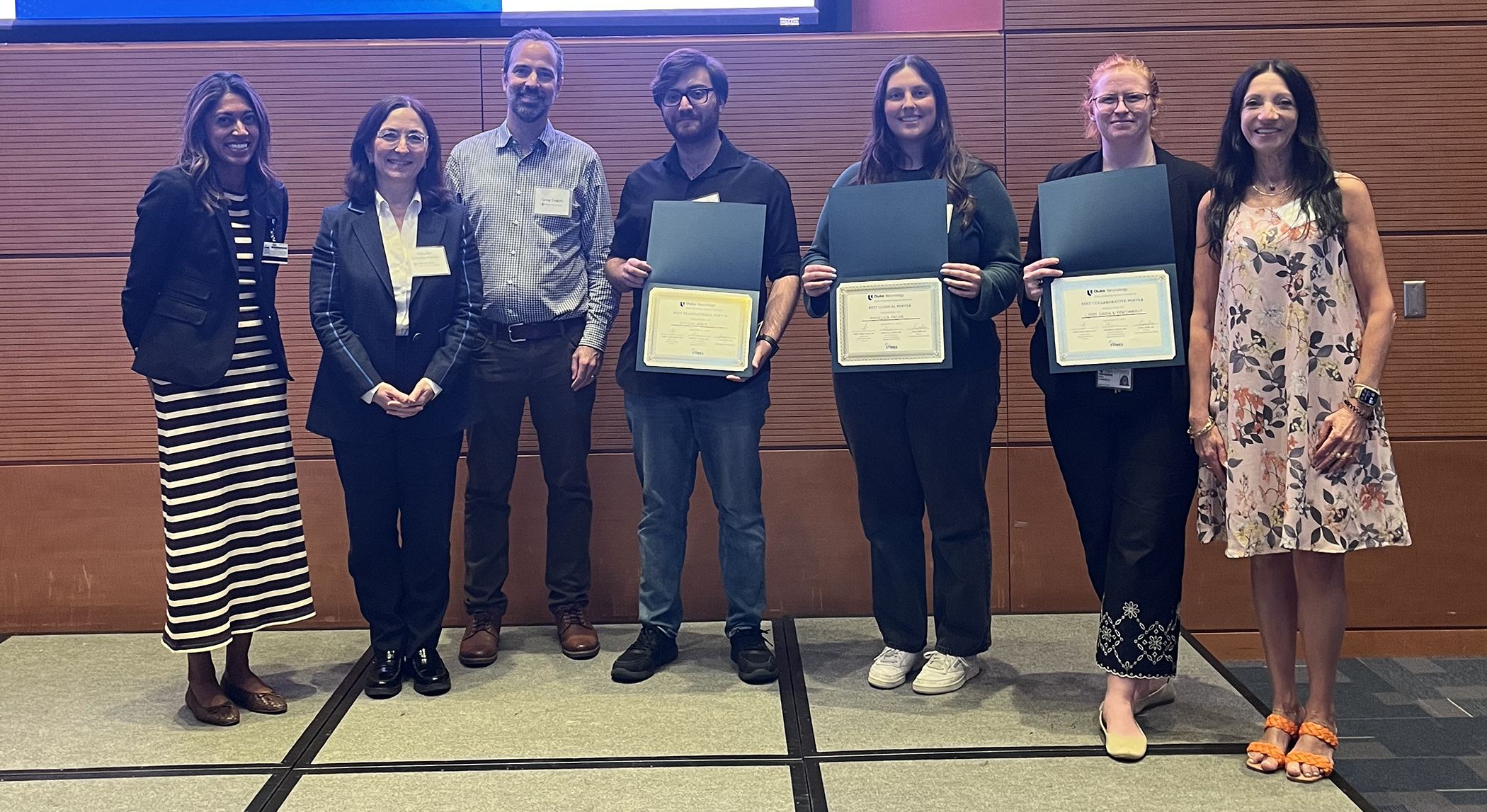
Best Translational Poster: Kassem Jaber
Best Clinical Poster: Annelisa Fache
Best Collaborative Poster: Erin Connolly & Libby Gough

Special thank you to Duke University Stores for providing prizes for the 2026 Symposium.
2026 Symposium Schedule
Poster Viewing
4:00pm – 5:30pm
Opening Remarks
5:30pm – 5:40pm
Ornit Chiba-Falek, PhD
Presentation — “Pathway to Precision Medicine in Neurodegenerative Diseases”
5:40pm – 6:20pm
Nilufer Ertekin-Taner, MD, PhD
Chair, Department of Neuroscience
Roy E. & Merle Meyer Professor of Neuroscience
Professor of Neurology and Neuroscience
Mayo Clinic Jacksonville, FL
Awards
6:20pm – 6:30pm
Ornit Chiba-Falek, PhD • Gregory B. Cogan, PhD
Best Translational • Best Clinical • Best Collaborative
2026 Poster Submissions
Poster submissions from the Duke community are organized by neurological topic researched. Information includes the primary author and the location of the poster at the symposium.
To submit a poster proposal for the 2026 Research Symposium, use this link.
- Submissions will be accepted on a first come, first served basis through the deadline of 9:00am Wednesday, August 26.
- Posters should be no larger than 5 feet wide by 3 feet tall.
- It is the responsibility of the presenter to print their own poster and the Duke Department of Neurology is unable to provide printing services to participants.
- Posters should be finalized and available to display by 3:00pm Tuesday, September 15.
Convergent Neuroanatomical Architectures Across Alzheimer's Disease Risk Factors
- Author: Aarushi Singh
- Department: Biomedical Engineering
- Location: Screen 1
Identification of Inhibitors for Amyloid-beta in Alzheimer's Disease and Cerebral Amyloid Angiopathy
- Author: Aarav Vakani
- Department: Neurobiology
- Location: Screen 1
Long-Read Transcriptomic Gene Expression Reveals Alzheimer's Disease Associated Isoform Diversity in an African American Ancestry Cohort
- Author: Srilakshmi Venkatesan
- Department: Neurology
- Location: Screen 1
A diagnostic and prognostic plasma omics-biomarkers panel for Alzheimer’s Disease based on microglial single-cell transcriptomics
- Author: Michael Lutz, PhD
- Department: Neurology
- Location: Screen 2
Methionine, Mitochondria, Metabolism.... the M&M's of AD
- Author: Carol Colton, PhD
- Department: Neurology
- Location: Screen 2
Alzheimer’s Disease and Tuberous Sclerosis Complex as Related Tauopathies
- Author: Michael Terranova, MD, MSc and Cynthia Ding
- Department: Neurology
- Location: Screen 2
The Duke Mouse Brain Atlas: MRI and light sheet microscopy stereotaxic atlas of the mouse brain
- Author: G Allan Johnson, PhD
- Department: Biomedical Engineering
- Location: Screen 3
Magnetic resonance microscopy maps widespread effects of Alzheimer’s disease on brain structures in mice
- Author: Len White, PhD
- Department: Neurology
- Location: Screen 3
Statistical atlases of the aging mouse neurophenome
- Author: Len White, PhD
- Department: Neurology
- Location: Screen 3
APOE-Targeted Microglia-Specific Epigenome Therapy for Alzheimer’s Disease
- Author: Bernadette O'Donovan, PhD, MSc
- Department: Neurology
- Location: Screen 4
Oligodendrocytes play a major role in Alzheimer’s disease through ancestry and sex-dependent effects on gene expression and cellular networks
- Author: E. Keats Shwab
- Department: Neurology
- Location: Screen 4
Computerized Crossword Puzzle Training in MCI (COGIT-2): Enhancing Clinical Trial Recruitment Using SlicerDicer at Duke
- Author: Gloria Xie
- Department: Psychiatry
- Location: Screen 5
From Donor to Discovery: Connecting Investigators with Human Brain Tissue for Neurodegenerative Research
- Author: Libby Gough and Erin Connolly
- Department: Pathology
- Location: Screen 5
Biochemical Analysis of a TrkB Receptor Mutation that Causes a Developmental Epileptic Encephalopathy
- Author: Yangzhong Huang, PhD
- Department: Neurobiology
- Location: Screen 10
Multimodal Deep Phenotyping Reveals Data-Driven Patient Clusters in Temporal Lobe Epilepsy
- Author: Petr Klimes, PhD
- Department: Neurology
- Location: Screen 10
Thalamic spindles reflect a protective mechanism against epileptic activity: a combined sleep-thalamic stereo-EEG study in focal refractory epilepsy
- Author: Kassem Jaber, MSc
- Department: Neurology
- Location: Screen 10
Cross-patient alignment improves simulated real-time speech decoding
- Author: Zachary Spalding
- Department: Biomedical Engineering
- Location: Screen 11
A uniqueness-point-locked component of lexical access is shared across active and passive tasks
- Author: Jianghao Qian
- Department: Biomedical Engineering
- Location: Screen 11
Multimodal Sensory-Motor Transformations for Speech
- Author: Areti Majumdar
- Department: Biomedical Engineering
- Location: Screen 11
Pretraining for Sample Efficient Neural Interfaces
- Author: Ben Tang
- Department: Neurology
- Location: Screen 12
Inquiry on TRPV4 involvement in head pain induction following murine mild traumatic brain injury
- Author: Martina Hernandez, PhD
- Department: Neurology
- Location: Screen 6
LPA/LPAR signaling drives temporomandibular disorders-like pain by sensitizing PIEZO2
- Author: Shanchun Su
- Department: Neurology
- Location: Screen 6
Tracking Dystonia Without Markers: Calibration Free 3D Hand Pose Reconstruction
- Author: Ben Tang
- Department: Neurology
- Location: Screen 12
Investigating the Role of LRRK2 in the Formation of Granulovacuolar Degeneration Bodies (GVBs)
- Author: Sarah Yim
- Department: Neurology
- Location: Screen 13
Cell-Type Specific Molecular Signatures of PD and DLB in African-Ancestry Donors Revealed by Single-Cell Long-Read Sequencing
- Author: David Axon
- Department: Neurology
- Location: Screen 13
Dystonia Biofluid Biomarker Discovery for Patient Stratification and Target Engagement
- Author: Zachary Caffall
- Department: Neurology
- Location: Screen 13
Impaired dopamine and acetylcholine signals during sensorimotor learning in preclinical model of torsion dystonia
- Author: Carlo Vignali
- Department: Neurobiology
- Location: Screen 14
Anticholinergic-Induced One Day Accelerated TMS in Cervical Dystonia
- Author: Annelisa Fache
- Department: Biomedical Engineering
- Location: Screen 14
One day accelerated 10 Hz rTMS for Focal Hand Dystonia: A Phase II Clinical Trial
- Author: Ian Xu
- Department: Biomedical Engineering
- Location: Screen 14
CODE ICH: Advancing the acute management of intracerebral hemorrhage
- Author: Alexis Lorio, MD
- Department: Neurology
- Location: Screen 7
Predicting Upper Extremity Spasticity 90 Days After Stroke Using Decision Tree Models Integrating Motor Impairment And Corticospinal Integrity Measures
- Author: Ergi Spiro
- Department: Neurology
- Location: Screen 7
Impact of stimulation Dose and Spatial Distribution on cortical excitability and motor learning in stroke patients - Preliminary Results
- Author: Lei Zhu
- Department: Neurology
- Location: Screen 8
Anatomical, Functional, and Structural connectivity-Based TMS Targeting of Motor System in Stroke
- Author: Jacques Stout
- Department: Neurology
- Location: Screen 8
Concordance between Visual Radiologist Assessment and Automated Volumetric Measures of Regional Brain Atrophy
- Author: Jiung Nam
- Department: Radiology
- Location: Screen 9
fMRI Measures of the Human Brain and Associations to Behavior
- Author: Andrew Michael, PhD
- Department: DIBS
- Location: Screen 9
Structure-Function Coupling in the Human Brain and Links to Behavior
- Author: Andrew Michael, PhD
- Department: DIBS
- Location: Screen 9